
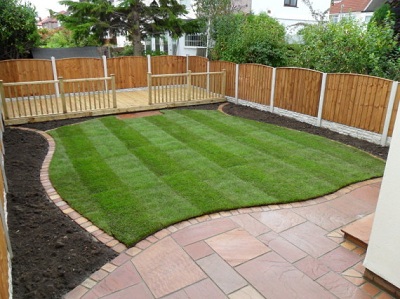
A new lawn fails for a boring reason. Turf laid on compacted spoil, or on clay that has not been levelled, sits wet in winter and shrinks in a dry July. The green photograph looks fine for a month.
John Mason’s garden in St Albans is the published case. The lawn already there was half dead, the soil was poor, and seeding topsoil was brought in before the new turf. The edge between that grass and the sandstone is block paving, so the mower has a line to follow.
Where the grass is worth having
Families still want a piece of lawn. The useful drawing keeps it where children play or where a mower can finish in one pass, and puts stone or gravel on the routes to the bins and the sitting spot.
Mrs Antony’s Hertford garden is the other end of the same choice: lawn with a paved edge, gravel on the change of level, and a working area at the bottom. The grass is a surface with a job, not the whole plot.
Through St Albans the ground shifts from clay towards chalk, so the preparation is judged on the garden in front of the crew rather than assumed from the postcode. Elstree and Borehamwood are more consistently the heavy clay.
If the lawn is going to be on a monthly visit afterwards, say so. Aeration and scarifying are maintenance jobs, not a substitute for a base that was never put in.